

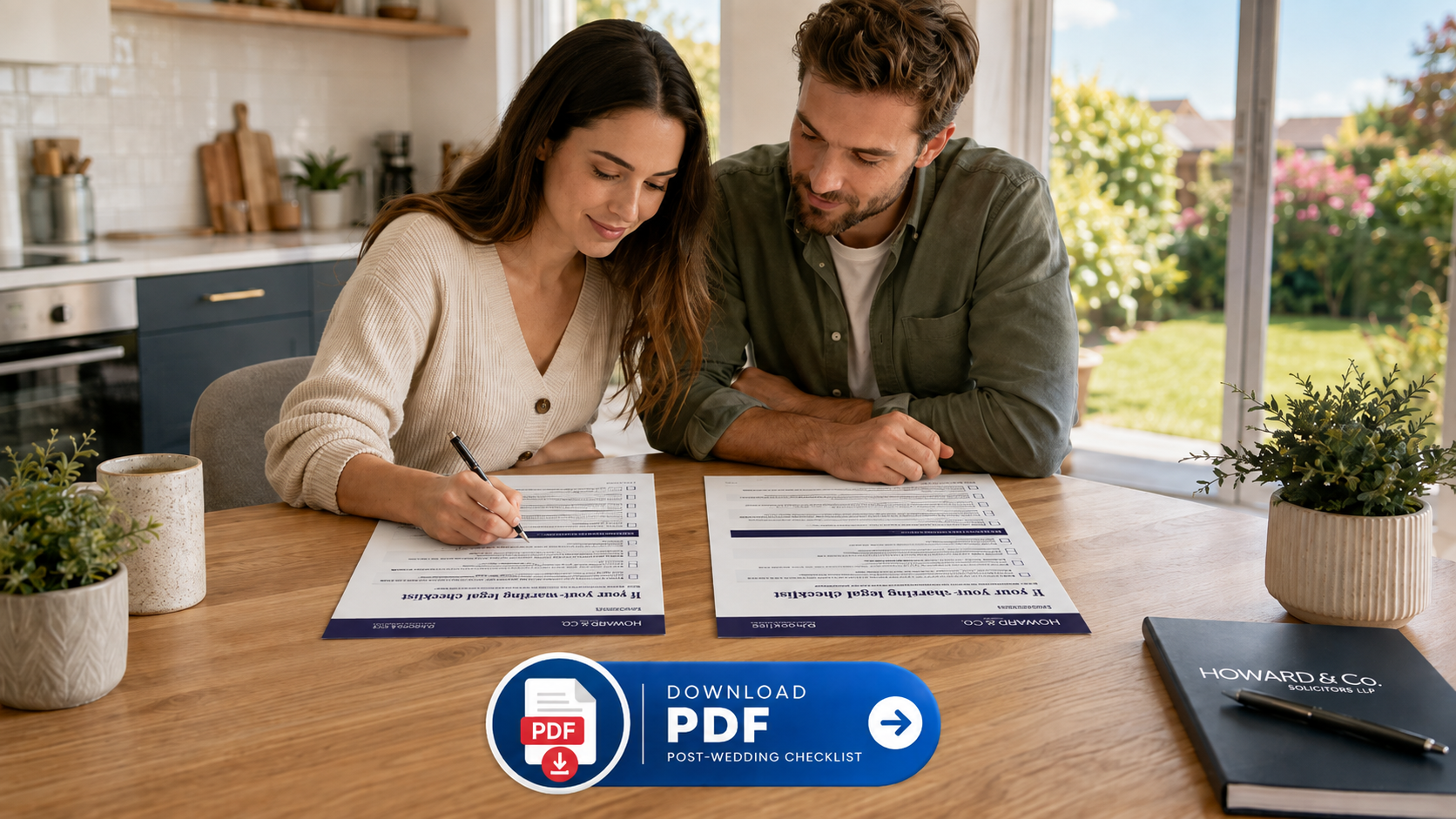
Your Post-Wedding Legal Checklist
Welcome to married life! Following the chaos, stress and excitement of your wedding, it's easy to overlook or procrastinate over the legal and administrative steps that follow the ceremony (sorry for being the killjoy!)
Marriage changes your legal position in ways that catch even careful, organised couples off guard, particularly when it comes to an existing Will. Others are simply good housekeeping - updating your name on official documents, or making sure your bank accounts work the way you expect them to.
At Howard & Co. Solicitors, we have been helping families across Barnsley and Penistone with exactly this kind of practical, plain-English legal advice since 1976. This guide walks through what is legally required, what is strongly recommended, and what only applies depending on your own circumstances, so you know where you actually stand.
This article covers the law of England and Wales only. If you married in Scotland or Northern Ireland, or you live there now, the rules on Wills, property and intestacy are different, and you should seek advice locally.
You may also want to check out our Wedding Legal Checklist: Marriage Documents and Certificates article to make sure all the paperwork has been completed immediately following your wedding.
Your Will: What Marriage Really Does to It
This is the single most important thing on this list.
Under a longstanding rule in the Wills Act 1837, getting married automatically cancels any Will you made before the wedding. It does not matter how carefully that Will was drafted, or how strongly you still feel about who should inherit what. In the eyes of the law, it simply no longer exists.
If you were to pass away without making a new Will after marriage, your estate would not automatically go to your new spouse in full. Instead, it would be divided according to the fixed rules of intestacy, which decide who inherits based on your family circumstances rather than your personal wishes. For couples with children from a previous relationship, stepchildren, or assets they want to leave to someone other than their spouse, this can produce a result nobody in the family actually wanted.
There is one narrow exception. A Will can be drafted "in contemplation of marriage" to a specific, named person, stating clearly that it is not meant to be revoked by that marriage. This is a precise piece of drafting rather than a general clause, so it needs to be done correctly to work.
Our Wills & Trusts team can help you put a Will in place that actually reflects your circumstances as a married couple.
Lasting Powers of Attorney: Why Marriage Doesn't Give You Automatic Authority
This surprises a lot of newly married couples. Many assume that once you are married, your husband or wife can automatically step in and make decisions for you, or access your bank account, if you were seriously ill or lost mental capacity. In England and Wales, that simply is not the case.
Without a Lasting Power of Attorney (LPA) in place, your spouse has no automatic legal right to manage your finances, speak to your bank, or make decisions about your medical treatment on your behalf, even after decades of marriage. If something happened and no LPA existed, your spouse would likely need to apply to the Court of Protection to be appointed as a deputy, which is a slower, more expensive and more stressful process than putting an LPA in place in advance.
There are two types of LPA, and most couples benefit from having both:
- Property and Financial Affairs LPA - lets your attorney manage your bank accounts, bills and property.
- Health and Welfare LPA - lets your attorney make decisions about your medical care and daily welfare if you are unable to make them yourself.
Registering each LPA with the Office of the Public Guardian currently costs £92 (see our up-to-date legal costs list page), with reduced fees available for people on a low income or certain benefits (these figures are correct at the time of writing and are worth double-checking on GOV.UK, as they do change from time to time). It is entirely possible to complete the forms yourself, but many couples prefer a solicitor's involvement to make sure the paperwork is right first time, particularly where property, a business or a blended family is involved. Our Wills, Probate & Trusts team can guide you through this alongside your Will.
Property: Joint Tenants or Tenants in Common?
If you own, or are about to buy, a home together, the way that property is legally held matters a great deal, and it is not something most couples think about beyond signing the mortgage paperwork.
There are two ways to jointly own a property in England and Wales:
- Joint tenants - you both own the whole property together, with no fixed individual share. If one of you dies, the property passes automatically to the survivor, regardless of what either of your Wills says.
- Tenants in common - you each own a specific, defined share of the property (which does not have to be equal), and each share can be left to whoever you choose in your Will.
Many couples buying their first home together choose joint tenants without giving it much thought, and for a straightforward marriage with no children from previous relationships, that is often the right outcome. But it is worth actively reviewing, rather than assuming, particularly if:
- One of you owned the property before the marriage and the other has since moved in or contributed to it.
- You contributed unequal amounts towards the purchase and want that reflected.
- Either of you has children from a previous relationship you want to provide for.
In these situations, holding the property as tenants in common alongside a Declaration of Trust, a document setting out exactly who owns what share and on what terms, can protect both of you and avoid disputes later. HM Land Registry does not automatically record or track this kind of arrangement, so it needs to be set up deliberately. If you are buying a home together for the first time as a married couple, or want to review how an existing property is held, our Residential Conveyancing team can advise.
Changing Your Name (and What You Don't Have to Change)
Taking your spouse's surname is a personal choice, not a legal requirement. You are free to keep your own name, adopt your spouse's, double-barrel the two, or do nothing at all - the marriage itself does not force any change.
If you do want to change your surname to your spouse's, or take a double-barrelled version of both your names, your marriage certificate is normally accepted as proof by most organisations, without any need for a deed poll. A deed poll is generally only needed if you want to create an entirely new combined surname, or make a change that goes beyond what is shown on the certificate.
Once you have decided, it is worth ordering a few extra certified copies of your marriage certificate from the register office, as several organisations will want to see an original.
A practical point worth flagging: if you hold a driving licence, updating your name with the DVLA is not just good practice, it is a legal requirement. You must notify the DVLA when your name changes, and you could be fined for failing to do so. Updating your passport, by contrast, is not compulsory, but it is strongly recommended if you plan to travel, since names that do not match across your documents can cause problems at check-in and border control.
A reasonably comprehensive list of who to notify includes:
- DVLA (your driving licence - by law, and free of charge)
- HM Passport Office (your passport - not compulsory, but recommended)
- HMRC (via your Personal Tax Account, for your tax and National Insurance records)
- Your bank, building society and any credit providers
- Your employer, for payroll, pension and HR records
- Your GP, dentist and any other healthcare providers
- Your mortgage lender or landlord
- Utility providers, your local council (for council tax) and the electoral roll
- Insurance providers (car, home, life and travel policies)
Money Matters: Tax, Bank Accounts and HMRC
Marriage Allowance
Marriage Allowance is a genuinely useful, and widely under-claimed, tax break. If one of you earns below the personal tax-free allowance and the other pays tax at the basic rate, the lower earner can transfer a portion of their unused personal allowance to their spouse, reducing the higher earner's tax bill by up to a couple of hundred pounds a year. It can also be backdated for previous tax years if you were eligible but did not claim. It is free and quick to apply for directly through GOV.UK, and worth checking even if you assume you will not qualify.
Joint or separate bank accounts
There is no legal obligation to combine your finances when you marry, and plenty of couples choose to keep some or all of their accounts separate. If you do open a joint account, it is worth understanding what that actually means: both of you have full access to the funds, and both of you are equally responsible for the account, including any overdraft. If your spouse overspends or runs up debt on a shared account, you can be held jointly liable for it, so it is worth a proper conversation about how you intend to use it before opening one.
Inheritance Tax and the spouse exemption
One genuine benefit of marriage is the inheritance tax spouse exemption: anything you leave to your husband or wife on death is generally exempt from Inheritance Tax entirely, regardless of the value, provided both of you are UK residents for tax purposes. Any part of your tax-free allowance (the nil-rate band) that goes unused on the first death can also usually be transferred to the surviving spouse, which can significantly increase the amount a couple can pass on tax-free in the longer term. This is a good example of why reviewing your Will after marriage matters. It is not only about who inherits, but about making sure your estate is structured tax-efficiently as a married couple.
Pensions, Life Insurance and Death-in-Service Benefits
This is one of the most commonly missed steps, largely because it does not feel like a "legal" job in the way a Will does.
Most workplace pensions, personal pensions and life insurance policies written in trust are not controlled by your Will at all. Instead, they are usually paid out at the discretion of the pension trustees or insurer, guided by a form you complete separately, often called an "expression of wish" or nomination form. If that form still names an ex-partner, a parent, or simply nobody at all, your Will cannot override it.
Because each pension scheme, workplace death-in-service benefit and insurance policy has its own separate nomination, getting married is a good moment to go through each one individually and update your named beneficiary, rather than assuming a new Will will cover it. This applies to:
- Workplace and personal pensions
- Life insurance policies
- Death-in-service benefits through an employer
- Any other policies with a "nomination of beneficiary" option
Prenuptial and Postnuptial Agreements
Most people associate these agreements with the run-up to a wedding, but a postnuptial agreement, entered into after you are already married, is worth knowing about too.
Neither a prenuptial nor a postnuptial agreement is automatically binding on a court in England and Wales in the way a straightforward contract would be. However, since a landmark Supreme Court decision in 2010, courts will generally give these agreements significant, often decisive, weight on divorce, provided the agreement was entered into freely, both people understood its implications, each had independent legal advice, and the outcome is not fundamentally unfair to either person or to any children involved.
A postnuptial agreement can be worth considering after the wedding in situations such as:
- You meant to arrange a prenuptial agreement but ran out of time before the wedding.
- Your financial circumstances have changed significantly since marrying - for example, an inheritance, a business you have built up, or a property bought in one person's name.
- You are in a second marriage and want to protect assets for children from a previous relationship.
- You simply want the clarity and reassurance of setting out how finances would be handled, without it being a sign of anything being wrong in the relationship.
Family law in this area is genuinely nuanced, and getting the agreement right, so that a court is likely to uphold it, matters. Heather Wheelhouse, Partner and Head of our Family Law department, leads the team at Howard & Co who advise on these agreements alongside the full range of family and relationship matters. You can read more about Heather and the Family Law team here, or visit our Family & Relationships services page for more information.
If You or Your Partner Have Children From a Previous Relationship
Blended families raise a few extra points worth thinking through together, on top of everything above:
- Your Will needs to say clearly what you want to happen for your own children if you die, rather than leaving it to intestacy rules, which may not provide for stepchildren at all unless they were legally adopted.
- Property ownership as tenants in common, alongside a Declaration of Trust, can allow you to leave your share of the family home to your own children while still protecting your spouse's right to live there.
- Guardianship of any children under 18 should be addressed directly in your Will if you have not already done so.
- Lasting Powers of Attorney are just as relevant here, particularly where family relationships are more complex and you want to be certain who is legally able to act for you.
None of this needs to be complicated, but it is exactly the kind of situation where a short conversation with a solicitor can prevent a much bigger problem for your family later on.
Other Things Worth Checking
A few smaller items that are easy to overlook, but worth a quick check:
- Car and home insurance - premiums and cover can be affected by a change in named drivers, address or joint ownership, so it is worth reviewing your policies rather than assuming nothing has changed.
- Employer benefits - some employers offer benefits such as private medical insurance or additional life cover that can be extended to a spouse, but usually only if you actively notify HR.
- Immigration status - if either of you is not a British citizen, marriage can affect visa applications or eligibility, and this is a specialist area worth taking separate advice on promptly.
Your Post-Wedding Legal Checklist at a Glance
To bring this all together, here is how these steps break down by how essential they are:
Legally required, in certain circumstances:
- Updating your name with the DVLA if you hold a driving licence and are changing your name.
- Making a new Will if you want your estate to pass as you intend - not compulsory in itself, but without one, your previous Will is void and intestacy rules will apply.
Strongly recommended for every couple:
- Making or reviewing a Will.
- Putting Lasting Powers of Attorney in place.
- Updating pension and life insurance beneficiary nominations.
- Reviewing how any property you own together is held.
Depends on your circumstances:
- Changing your surname and the documents that follow from it.
- Applying for Marriage Allowance.
- Opening a joint bank account.
- Considering a postnuptial agreement.
- Reviewing arrangements for children from a previous relationship.
Frequently Asked Questions
Does getting married cancel my old Will?
Yes, in almost all cases. Under the Wills Act 1837, marriage automatically revokes any Will you made beforehand, unless it was specifically drafted "in contemplation" of that particular marriage. If you do not make a new Will, your estate will be distributed under the intestacy rules rather than your previous wishes.
Do I have to change my surname when I get married?
No. Changing your name after marriage is entirely optional. You can keep your own name, take your spouse's, or combine the two - the choice is yours, and the marriage itself does not require any change.
Does my husband or wife automatically get power of attorney over me?
No. Marriage does not give your spouse any automatic legal authority to make financial or medical decisions on your behalf if you lose capacity. Without a registered Lasting Power of Attorney, your spouse would usually need to apply to the Court of Protection instead.
What is Marriage Allowance and am I eligible?
Marriage Allowance lets a lower-earning spouse transfer part of their unused personal tax allowance to a spouse who pays tax at the basic rate, reducing the higher earner's tax bill. It is free to apply for through GOV.UK and can sometimes be backdated, so it is worth checking your eligibility even if you are not sure you qualify.
Do we have to have a joint bank account after marriage?
No, there is no legal requirement to combine your finances. Many couples keep some or all accounts separate. If you do open a joint account, be aware that both of you are equally responsible for it, including any overdraft or shared debt.
Should we get a postnuptial agreement?
It depends on your circumstances, but it is worth considering if your financial situation has changed since marrying, you have children from a previous relationship, or you simply want clarity on how finances would be handled. Courts in England and Wales will generally give these agreements significant weight, provided they are entered into fairly and with independent legal advice on both sides.
Getting Married in Barnsley or Penistone?
If your wedding is still ahead of you, South Yorkshire has some genuinely great options close to home. A few well-regarded choices for local ceremonies and receptions include:
- Barnsley Civic - a striking Grade II listed building in the heart of Barnsley town centre, licensed for ceremonies from intimate gatherings to larger celebrations.
- Cannon Hall, Cawthorne - a Georgian country house set in 70 acres of parkland, with licensed ceremony spaces including the Ballroom, the Library and the outdoor Deer Shelter.
- Wortley Hall - a Grade II listed stately home set within 26 acres of gardens and woodland, just outside Barnsley.
- Cubley Hall, Penistone - a characterful country house venue with recently refurbished event spaces, popular for both ceremonies and receptions.
- The New Inn, Penistone - a licensed venue offering a striking setting for your ceremony in the town itself.
If you are planning a more personal or non-traditional ceremony, it is also worth speaking to Wendy Morgan-Gray at The Celebrant's Pen, an independent celebrant based in Penistone who writes and delivers bespoke wedding ceremonies tailored entirely to you as a couple.
How Howard & Co Can Help
Since 1976, we have supported families across Barnsley and Penistone through every stage of life, and getting married is exactly the kind of milestone where a little early advice goes a long way. Whether you need a new Will, want to put Lasting Powers of Attorney in place, are reviewing how your property is owned, or are thinking about a postnuptial agreement, our team is here to talk it through in plain English, without jargon or pressure.
This article provides general information about the law in England and Wales as at the time of writing (August 2026) and does not constitute legal advice. Legal requirements and tax rules can change, and how they apply will depend on your individual circumstances. Please contact Howard & Co for advice tailored to your situation before making any decisions.